

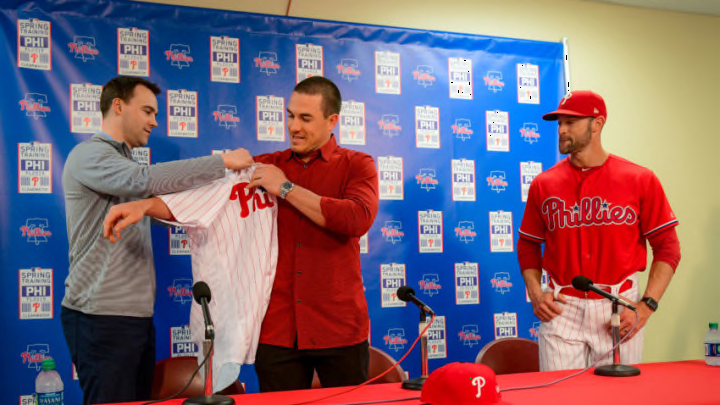

While the Phillies have no shortage of recommendations from the faithful, the responsibility to provide a competitive team rests on the shoulders of general manager Matt Klentak as the point man for the front office.
Wish list:
From the outside looking in, the Philadelphia Phillies aren’t immediately solving their current shortcomings to the fans’ satisfaction. However, spending money and trading prospects can sometimes complicate an overall strategy if they are only a short-term remedy. Translation: a one-month cure!
"IN OTHER WORDS: “Obstacles are those frightful things you see when you take your eyes off your goal.” – Henry Ford"
With the deadline approaching, fans are scrutinizing every liability daily and concluding a failure by the manager or GM. That stated, baseball executives have two roster-changing periods: the offseason and first-half’s end with rare exceptions. This is the norm like a closer working the ninth inning.
Basically, management makes winter acquisitions in preparation for the upcoming 162, but they can’t plug every hole, real or perceived. For instance, they can’t anticipate which developing players will succeed or struggle. Performances will determine that during the first three months, not just April.
And even if the stars are productive, they must also be healthy. Plus some stretch-drive decisions involve the organization’s finances and pipeline. So, Klentak will probably strengthen the weakest spots regarding effectiveness or injury and gamble on hopeful outcomes for the smaller holes.
During the offseason, Klentak added a catcher, shortstop, two corner outfielders and a fireman because the offense, defense, and ninth-frame had no in-house solutions. However, he had 11 qualified relievers for eight spots and four starters for three slots: no eliminations rotation-wise in March.
Every franchise balances their payroll by having a combination of high-salaried veterans and MLB-minimum youngsters. Additionally, some current regulars are stopgaps if a top-tier prospect will arrive in less than two campaigns. In other words, a club doesn’t sign a vet for four summers and block an MiLB star.
Presently, national writers and some impatient locals have decided the red pinstripes could need two starters, two or three relievers, a center fielder and a third sacker. Of course, a southpaw and/or two-slot hurler are the Fightins’ preferences.
 Add us as a preferred source on Google