

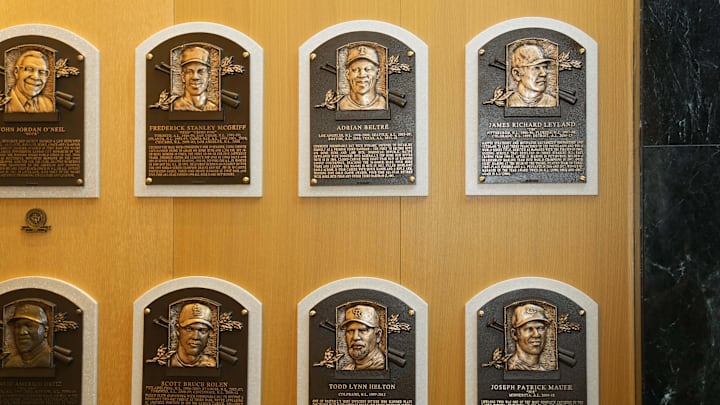
Which were the greatest Hall of Fame classes of all time?
Membership in the 2025 class will be finalized next week on Jan. 21 when results of the media vote are announced. We already know that the 2025 class will have at least two members since one of the Eras committees in December elected Dave Parker and Dick Allen.
Based on publicly announced voting to date, Ichiro Suzuki appears to be a lock for election, and C.C. Sabathia is a strong candidate. Billy Wagner and Carlos Beltran are also above the required 75% threshold currently, while Andruw Jones sits just beneath it.
What follows is a look at the best Hall of Fame classes for each 10-year period since the Hall’s inception in 1936. The choices are made on a two-pronged track. The first is objective greatness: How many were elected and how great were they? The second prong is more subjective: call it a personal favorite. For that prong, we'll look at cultural as well as performance considerations.
1936-1945

From a standpoint of greatness, it’s impossible to look beyond the inaugural class of 1936. Those were the five inductees who represented the game’s best from its inception to that point. Their names are legend: Ty Cobb, Honus Wagner, Babe Ruth, Christy Mathewson and Walter Johnson.
At the time, Cobb was the career hits leader, Ruth the career home run leader, Johnson the career strikeout leader, and Wagner the consensus best fielder. As for Mathewson? He combined a 373 win total with a role-model reputation.
"Conceded to be the fastest ball pitcher in the history of the game."Walter Johnson's Hall of Fame plaque
There was no such statistic as WAR in that era, but applying it today does nothing to undermine the status of that inaugural class. The five averaged 139.86 WAR between them, still easily the highest average for any Hall class consisting of more than one member.
For the first decade, that 1936 class did have some competition. That was especially so of the 1937 group, when voters rectified their 1936 oversight and elected 511-game winner Cy Young as part of a class of eight. That same class featured Tris Speaker, Nap Lajoie, Johnn McGraw and Connie Mack.
1936-45 personal favorite: It’s impossible to look past the inaugural 1936 class.
1946-55

Voters took a tougher approach after the first few classes. In four of the 10 years in this window, voters failed to elect anyone, and in 1946 the 263 voters adopted the most curmudgeonly approach in HOF history. Not only did they fail to elect anyone, but the average ballot contained just 5.01 names, an all-time low.
Here’s a simple way to illustrate how strict a line voters hewed during this period: In 1955, they elected Joe DiMaggio with 88.8 percent of the vote in his fourth year on the ballot. DiMaggio had been denied entry in 1945 (0.4 percent), and again in 1953 (44.3 percent) and 1954 (69.4 percent). That’s a tough crowd.
"One of few players to jump from a high school team into the majors."Mel Ott's Hall of Fame plaque
Objectively, the decade’s most distinguished class was probably in 1951. The two winners were Mel Ott and Jimmie Foxx. Ott, who hit 511 home runs in an era when that meant something, was named on 87.2 percent of ballots. Foxx, who hit 58 homes in 1932 and 534 for his 20-season career, was named on 79.4 percent of ballots.
1946-55 personal favorite: In 1946, Hall voters — who had enshrined only Rogers Hornsby since 1940 — again voted nobody in. But that didn’t stop an Old Timers Committee. That group of former players and executives enshrined 11 of their contemporaries, an all-time record. Among the honorees: Ed Walsh, Jack Chesbro, Jesse Burkett and Rube Waddell.
1956-1965

Among a relatively mundane succession of election results, one clearly stands out. In 1962, Hall voters enshrined pitching great Bob Feller and groundbreaking Dodger Jackie Robinson.
The Robinson election, with 77.5 percent of the 160 voters, had and still has obvious profound cultural implications. Aside from that, he was 1947 Rookie Of the Year, 1949 MVP, 1949 batting champion (.342), and a key figure on seven pennant winners, among them the 1955 World Champions.
"A player of extraordinary ability renowned for his electrifying style of play."Jackie Robinson's Hall of Fame plaque
That's not meant to overlook Feller, who was named on 93.8 percent of the ballots. A 266-game winner who lost all or most of four seasons to Naval combat service during World War II, he set the strikeout record, seven times leading the league in that category.
1956-65 personal favorite: There’s no getting past the Feller-Robinson 1962 enshrinement, both for the quality of the candidates and also for the social and cultural implications. And, for what it’s worth, that 1962 class also included a pair of old-timers: Edd Roush and Bill McKechnie.
1966-1975

The most common writers’ election result is one. Two dozen Hall elections have resulted in a single enshrined player. The interesting thing is how often that single honoree is widely recognized as one of the all-time greats.
"Named player of the decade from 1951-1960."Ted Williams' Hall of Fame plaque
That occurred in 1942 with the election of Rogers Hornsby, again in 1973 (Warren Spahn), 1977 (Ernie Banks), 1978 (Eddie Mathews), 1979 (Willie Mays), 1981 (Bob Gibson), 1988 (Willie Stargell), and 1995 (Mike Schmidt). But the pinnacle single-winner choice came in 1966, when Ted Williams won election with 93.4 percent of the vote.
Today, Williams is frequently mentioned among the two or three greatest hitters of all time, with good reason: he had a career .344 average, 521 home runs, a staggering .482 lifetime on base average, and a .634 slugging average.
1956-65 personal favorite: What really made Williams’ selection stand out was his induction address. In it, he pushed for the inclusion of great players of the segregation-era Negro Leagues within the Hall’s ranks.
That push bore fruit: By 1972, the first class of Negro League stars were inducted (making up another all-time great class), with Williams on the podium to watch approvingly.
1976-85

This was a decade when Hall voters were presented with — and accepted — a succession of single candidate ballots. Banks went in in 1977, Mathews in 1978, Mays in 1979, and Gibson in 1981.
All were obviously worthy, but all were also singular. The 1982 writers class only consisted of two names, but what a pair they were. Hank Aaron was the all-time home leader at the time with 755, a former MVP, a two-time batting champion, and the key figure on Milwaukee’s 1957 World Series run.
"Hit 755 home runs in 23-year career to become majors all-time homer king."From Hank Aaron's home run plaque
His enshrinement partner, Frank Robinson, echoed Aaron’s credentials. A Rookie of the Year and two-time MVP, he hit 586 home runs with a career .926 OPS.
Even the hard-to-please voters were impressed: they voted Aaron in with 97.8 percent and Robinson with 89.2 percent. It was the first time since the inaugural Hall vote that two candidates had both topped 89 percent. In the more than 40 succeeding elections, that’s only happened six more times.
1977-86 personal favorite: Ernie Banks was my childhood hero. His 1977 election stands out.
1986-95

As with Aaron and Robinson in 1982, 1989 was one of those rare moments when two enshrinees stood out.
At least during his peak period, Johnny Bench may have been the greatest catcher the game has ever seen. A Rookie of the Year and two-time MVP, he led the Reds to the 1975 and 1976 World Series titles in the midst of a 17-season career. Between 1968 and 1980, no All-Star Game was played without Johnny Bench on the scene.
Perhaps Bench’s greatest moment, his team’s 1975 World Series victory in Boston came at the expense of his fellow inductee, Carl Yastrzemski. An 18-time All Star and 1967 MVP, Yastrzemski played 3,308 games, every one of them for the Boston Red Sox. That, in case you are wondering, is the record for games played with a single team.
"Redefined standards by which catchers are measured during 17 seasons with the Big Red Machine."From Johny Bench's Hall of Fame plaque
Voters had no hesitancy ratifying their credentials. Bench was elected with 96.4 percent, Yaz with 94.6 percent. That was the first time two candidates topped 93 percent; it’s only happened twice since.
1986-95 personal favorite: It’s rare to be able to say you saw the player who was beyond question the greatest player ever at his position. Mike Schmidt was beyond question the greatest ever to play third base. In 1995, he won induction with 96.5 percent. Case closed.
1996-2005

Perhaps the greatest Hall class since the inaugural 1936 one arrived in 1999. It featured three legends: Nolan Ryan, George Brett and Robin Yount.
The careers of Brett and Yount can be summed up simply. Brett was the greatest Royal ever; Yount was the greatest Brewer. You’d be hard-pressed to find a half dozen fans of either team to argue that point.
"A fierce competitor and one of baseball's most intimidating figures on the pitching mound."From Nolan Ryan's Hall of Fame plaque
Ryan had no team — he pitched lengthy stints with the Angels, Astros and Rangers after coming up with the Mets. His record, however, is staggering. For starters, he pitched through parts of 27 seasons, debuting in 1966 and retiring in 1993. Ryan’s 324 victories came in a stunning 616 decisions, a total that is still fourth all time behind only Cy Young, Walter Johnson and James Galvin.
For good measure, he still holds the career strikeout record (5,714), which likely won't be broken any time soon (or, potentially, ever).
1996-2005 personal favorite: If Nolan Ryan never existed, you’d still give this to the Brett-Yount 1999 class. How often have the greatest players in the history of two different franchises entered Cooperstown arm in arm?
2006-2015

Pick-em. Between 2006 and 2015, Hall voters produced two memorable HOF classes that are virtually indistinguishable from one another in terms of quality.
The 2014 class had three members. Between them, Greg Maddux and Tom Glavine won 438 games for the Atlanta Braves and 660 overall. Maddux won four Cy Youngs, Glavine two. Together, they made 18 All-Star Game rosters.
"Preparation, command and study of batters made him part-scientist, part-artist."From Greg Maddux's Hall of Fame plaque
The third 2014 honoree was Frank Thomas, every bit the slugger that Maddux and Glavine were pitchers. Probably the greatest player in White Sox franchise history, Thomas hit 521 home runs with a career .419 on base average and .974 OPS.
Maddux, Glavine and Thomas probably rate just ahead of the 2015 class, but it’s arguable. That quartet included Randy Johnson, Pedro Martinez, John Smoltz and Craig Biggio.
2006-15 personal favorite: This is a spot to save a bow for the 2007 class, which, as with 1999, features two players who may rank as the best ever produced by their franchises.
That’s obviously true for Tony Gwynn of San Diego. His fellow Hall of Famer, Cal Ripken, is deservedly a legend in Baltimore, although his place among a list of franchise greats that also includes Eddie Murray, Brooks Robinson and Frank Robinson is a debate I’m willing to let Orioles fans settle.
2016-Present

By comparison with Hall classes of prior years, recent classes have been devoid of jaw-dropping performers. For that reason, the honor of decade’s best probably goes to the class that is headed by the only unanimous inductee in Hall history. That would be the Mariano Rivera class of 2019, which also included Edgar Martinez, Roy Halladay and Mike Mussina.
Wins Above Replacement would probably give the honor to the 2017 class of Jeff Bagwell, Tim Raines and Ivan Rodriguez. That trio averaged a career 72.67 WAR, four points better than the 68.22 of the Rivera group.
"Devastating cut fastball frustrated batters, generating broken bats at a prolific rate."From Mariano Rivera Hall of Fame plaque
But WAR is notoriously unfriendly to relievers, which Rivera obviously was. Setting his personal WAR aside, the 2019 class averages 72.22, which is right there with 2017. The unanimity of Rivera’s election makes the difference.
2016-Present personal favorite. In 2022, the Hall’s Early Baseball Era Committee finally elected Buck O’Neil, who deserved enshrinement as much for his post-playing career as for anything he did on the field. In the Negro Leagues, O’Neil was a very good but not historically great first baseman. But, he was also a marvelous scout, a groundbreaking coach, and a spokesman of profound importance.
More From Around The MLB:
 Add us as a preferred source on Google