



MLB: The Franchise All-Time Bracket (NL Edition)
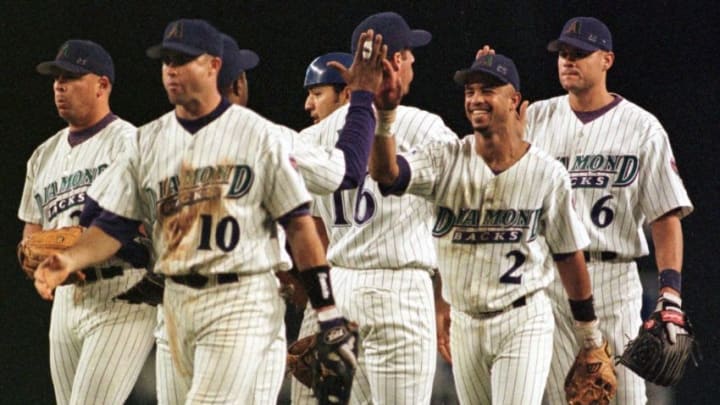
1905 New York Giants vs. 1999 Arizona Diamondbacks
The 1905 New York Giants were led by Christy Mathewson, whose Hall of Fame career may have peaked that year. Mathewson had a 31-5 record in 37 starts with a 1.28 ERA, and he covered 339 innings. Iron Man Joe McGinnity provided ample support, with a 21-15 record and 2.87 ERA in 38 starts and 320 innings.
Outfielder Mike Donlin led the offense with a .356 batting average while another outfielder, Sam Mertes, drove in 108 runs. In a dead-ball era, the Giants averaged an imposing 5.02 runs scored per game. The Mathewson-led pitching staff gave up just 3.26 runs per game.
The 1905 Giants won the New York-San Francisco bracket by defeating the 1937 Giants in four straight, taking out the 1962 San Francisco Giants in five, and winning the title in six games from the 1954 New York Giants.
Game 1: The 1905 Giants produced a .686 regular-season percentage, nearly 70 points higher than 1999 Arizona’s .617.
Game 2: The 1905 Giants won four of their five postseason games, a .800 percentage. The 1999 Diamondbacks had a .250 post-season percentage.
Game 3: in 1905 the Giants produced a 111 OPS+. The 1999 Diamondbacks only got to 101. The 1905 Giants lead this series 3-0.
Game 4: In 1905 the Mathewson-McGinnity Giants amassed a 124 staff ERA+. The 1999 Diamondbacks made a run at keeping the series alive, but their ERA+ stopped at 122.
Result: 1905 Giants in four games
1907 Chicago Cubs vs. 1976 Cincinnati Reds
Game 1: The 1907 Cubs produced a .704 regular-season percentage on a 107-45 record. The 1976 Reds were 102-60, .630 percentage. That’s a win for the Cubs.
Game 2: The 1907 Cubs tied one World Series game, and won their other four. The 1976 Reds won all seven of their post-season games. That takes us to a tie-breaker, which goes to the Reds. They had a +22 post-season run differential; the 1907 Cubs only got to a +13 run differential. The series is even at 1-1.
Game 3: The 1976 Reds generated a 120 OPS+, easily bettering the Cubs’ 92 OPS+.
Game 4: The Cubs have the pitching advantage, with a 143 ERA+. The reds only reached 100 in ERA+. The series is again tied at 2-2.
Game 5: The 1976 Reds had a 54.1 WAR. That’s a strong total, and it beats the 1907 Cubs’ 47.9.
Game 6: The 1907 Cubs fielded .967, eight points above the league average. The 1976 Reds fielded .984, but that was only seven points above the league average. The series goes to a seventh game, to be decided by Hall of Famers.
Game 7: The 1907 Cubs featured four Hall of Famers. They are first baseman Frank Chance, second baseman Johnny Evers, shortstop Joe Tinker, and pitcher Mordecai Brown. How about the 1976 Reds? Their immortals include second baseman Joe Morgan, catcher Johnny Bench and first baseman Tony Perez. The Reds are victimized by the absence of a potential fourth Hall of Famer, Pete Rose.
Result: 1907 Chicago Cubs in seven games

MLB: The Franchise All-Time Bracket (NL Edition)
1905 New York Giants vs. 1907 Chicago Cubs
Between 1905 and 1908, these two championship-caliber teams — who won all four National League pennants and three World Series –played each other 87 times. The Cubs won 51 of them…that’s .586 winning percentage in head-to-head play that may establish them as the favorite.
More from MLB News
- MLB Power Rankings: Atlanta Braves still on top with major shifting below them
- Caesars MLB Promo Code: Two Shots at Picking the World Series Winner!
- MLB Power Rankings: Atlanta Braves still on top amid a big shake-up in top 10
- DraftKings MLB Promo: Bet $5 on an Anytime Home Run, Win $150 Bonus GUARANTEED
- MLB Power Rankings: After MLB trade deadline, gap is closing on Atlanta Braves
The Cubs had particular fortune against the Giants ace, Mathewson. Over the course of those four seasons, The Cubs and Mathewson met 30 times, Matty emerging with only a 9-15 record with three saves. Chicago’s ace, Brown, was much more effective, going 18-7 against the Giants in 29 starts during that four-season cycle.
Game 1: The 1905 Giants had a 105-48 record and .686 percentage. But that’s still two games behind the 1907 Cubs, who were 107-45 for a .704 percentage.
Game 2: The Giants beat the American League champion Philadelphia Athletics in five games, a .800 post-season percentage. But the 1907 Cubs beat the Detroit Tigers four straight following a Game 1 tie, good for a 1.000 post-season percentage.
Game 3: The 1905 Giants offense was led by outfielder Mike Donlin, who batted .356. Right fielder Sam Mertes drove in 108 runs, while Hall of Fame catcher Roger Bresnahan hit .302. The team OPS+ was 111. The 1907 Cubs got by with average offense, their OPS+ reaching no higher than 92. That’s a 2-1 lead for the 1907 Cubs.
Game 4: Two titanic staffs are pitted against one another. The 1907 Cubs rode an extraordinary balance to a 143 ERA+. Jack Pfeister reached 214, Carl Lundgren 211, Mordecai Brown 178, Orval Overall 147, and Ed Reulbach 146. Mathewson was also extraordinary in 1905 reaching a 233 ERA+. But he lacked the support from his pitching mates, and thus the Giants staff ERA+ only got to 124. The Cubs lead 3-1.
Game 5: The 1907 Cubs staff compiled a 20.2 pitching WAR, lifting the team to an overall 47.9. But the 1905 Giants benefitted from by far the better offense, finishing at 54.4 WAR. That cuts the Cubs lead to 3-2.
Game 6: The 1907 Cubs fielded a stultifying .967 eight points higher than the National League average in that era. The 1905 Giants fielded .960, a solid six points above the league average. That, however, is two points short of the Cubs.
Result: 1907 Cubs in six games
The Cubs will advance to the final four, where they will meet the representative of the National League lower bracket.
Next up: The American League lower bracket. In chronological order, the eight teams in that portion of the bracket are the 1948 Cleveland Indians,1977 Kansas City Royals, 1991 Minnesota Twins, 2001 Seattle Mariners, 2002 Los Angeles Angels, 2008 Tampa Bay Rays, 2018 Boston red Sox and 2019 Houston Astros.